
What a Squeeze Bunt Is—and Why Its Scorebook Result Can Mislead
A squeeze bunt tries to score a runner from third. Here is how safety and suicide squeezes differ, how they are scored and how the play evolved.
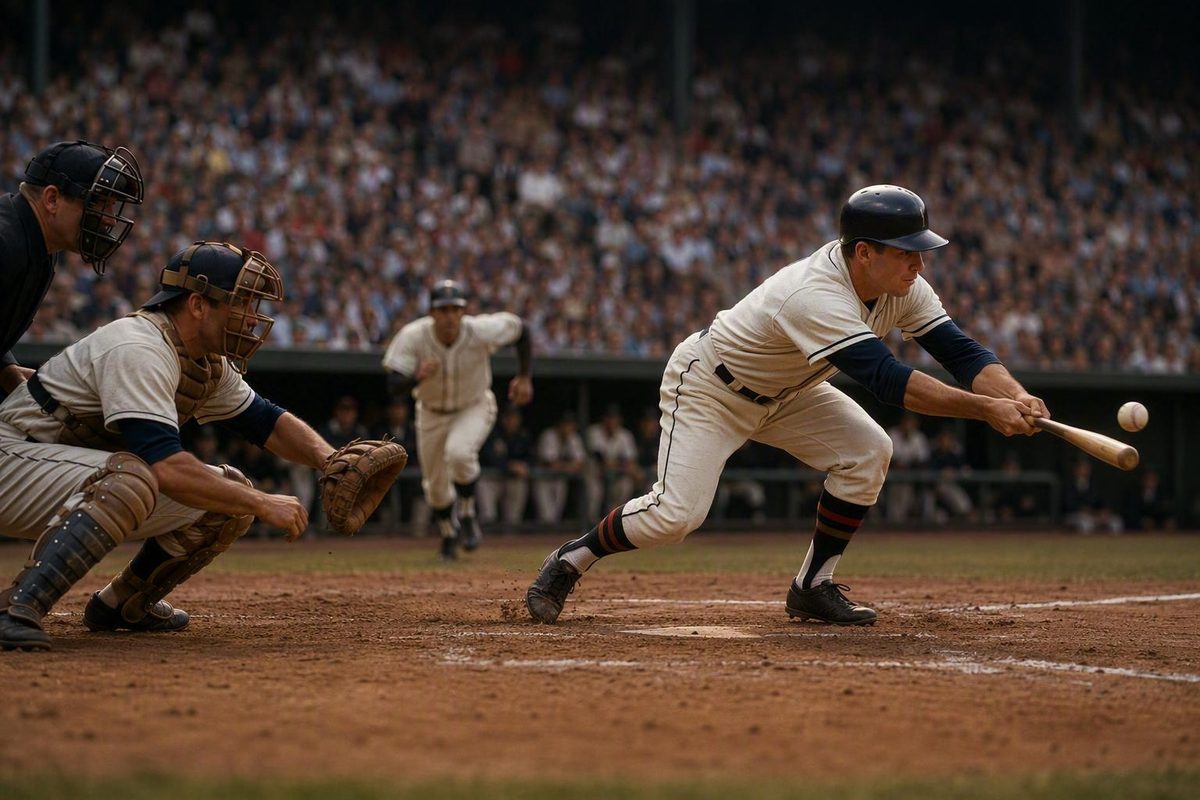
A squeeze bunt turns baseball’s smallest hit into a race for home. With a runner at third, the batter bunts to give that runner a chance to score. The batter may be conceding an out, but the play’s real objective is not merely to advance a runner—it is to produce a run.
That makes every squeeze a bunt, but not every sacrifice bunt a squeeze. A bunt that moves a runner from first to second is an ordinary sacrifice. MLB’s glossary specifically calls a bunt with a runner on third a squeeze play and says a successful sacrifice version is recorded as a sacrifice (MLB).
Safety squeeze vs. suicide squeeze
The difference is the runner’s timing.
- Safety squeeze: The batter bunts first. The runner at third breaks for home only after judging that the ball has been placed safely. The Dickson Baseball Dictionary definition describes the runner as going only when the bunt looks good. The late start makes the play safer for the runner but gives the defense more time to make a play at the plate.
- Suicide squeeze: The runner breaks with the pitch, before knowing whether the batter will make contact. That head start makes a run more likely on a properly placed bunt. A miss, pop-up or hard bunt near the pitcher can leave the runner trapped. The dictionary’s entry accordingly says that when the bunt fails, the runner is “almost always out” (Baseball Almanac).
The suicide squeeze therefore demands coordination more than surprise alone. The runner must commit, and the batter’s first responsibility is to put the ball on the ground. A hitter trying to make the bunt too perfect risks missing it entirely.
How the play appears in the scorebook
“Squeeze” describes the tactic, not one guaranteed scoring decision.
On a conventional successful squeeze, the batter is retired at first while the runner scores. The batter receives a sacrifice hit—usually shown as SH or SAC—and the plate appearance does not count as an at-bat, so it does not lower batting average or on-base percentage. If the batter beats the throw, however, the official scorer can award a bunt single instead of a sacrifice. MLB also notes that a batter can receive a sacrifice when an error allows him to reach (MLB).
With two outs, a squeeze cannot work as a literal sacrifice: if the defense retires the batter at first for the third out, the run does not count. The batter must reach safely, or the defense must try and fail to retire the runner at home. That distinction explains why a play can unquestionably be called a squeeze without producing an SH in the box score.
The batter normally receives an RBI when a run scores on a sacrifice bunt, but the official scorer can withhold one when an error is the reason the run scores. For the broader distinction between a run scoring and an RBI being awarded, see how RBI scoring works.
The names came after the tactic
Baseball’s vocabulary preserves an important historical wrinkle: “suicide squeeze” was not necessarily what early players called the aggressive version.
The Dickson Baseball Dictionary traces a printed use of safety squeeze to 1911 (Baseball Almanac). Its entry for suicide squeeze notes that the play had earlier been called simply a squeeze or a “do-or-die squeeze” (Baseball Almanac). A dictionary’s first-use citation documents surviving usage, not the invention of a tactic.
Bunting occupied a much larger place in the strategic culture of early baseball. Rube Foster made it mandatory for his Chicago American Giants hitters to practice bunting, reportedly requiring them to place balls into his hat. The Hall of Fame also recounts a remarkable 1921 game in which accounts differ on the exact number of consecutive bunts by Foster’s team (National Baseball Hall of Fame). The uncertainty matters, but so does the underlying picture: repeated bunting was plausible enough to belong to Foster’s tactical world.
The squeeze remained a valued specialist’s weapon in the mid-century major leagues. Phil Rizzuto’s Hall of Fame profile quotes teammate Gil McDougald remembering Rizzuto jumping to reach pitches on squeeze plays and still getting the run home (National Baseball Hall of Fame). The recollection captures the batter’s obligation on a suicide squeeze: once the runner commits, making contact can matter more than making an elegant bunt.
One bunt that breaks the usual definition
Ramón Hernández supplied a useful scoring lesson in Game 1 of the 2003 American League Division Series. Oakland and Boston were tied 4-4 in the bottom of the 12th, with the bases loaded and two outs. Hernández bunted, Eric Chávez scored, and Oakland won 5-4 (SABR). Because there were two outs, Hernández could not sacrifice himself and still end the game with a run. He reached on a bunt single.
SABR’s game account calls it a “perfect bunt” that drove in the winning run. MLB’s postseason retrospective notes that Hernández had recorded no bunt hits during the regular season (MLB). It was a squeeze by design, a hit by scoring, and a reminder that the tactic cannot always be identified from the SH column.
That is the cleanest way to read any squeeze bunt in baseball history: first identify the runner’s break, then the batter’s intent, and only then consult the scorer’s ruling. The play’s name explains the strategy; the box score records how that strategy actually ended.