
How Shibe Park Changed the Major-League Ballpark
The history of Shibe Park, from its 1909 opening and Athletics dynasties to Negro League games, the spite fence and its final Phillies season.
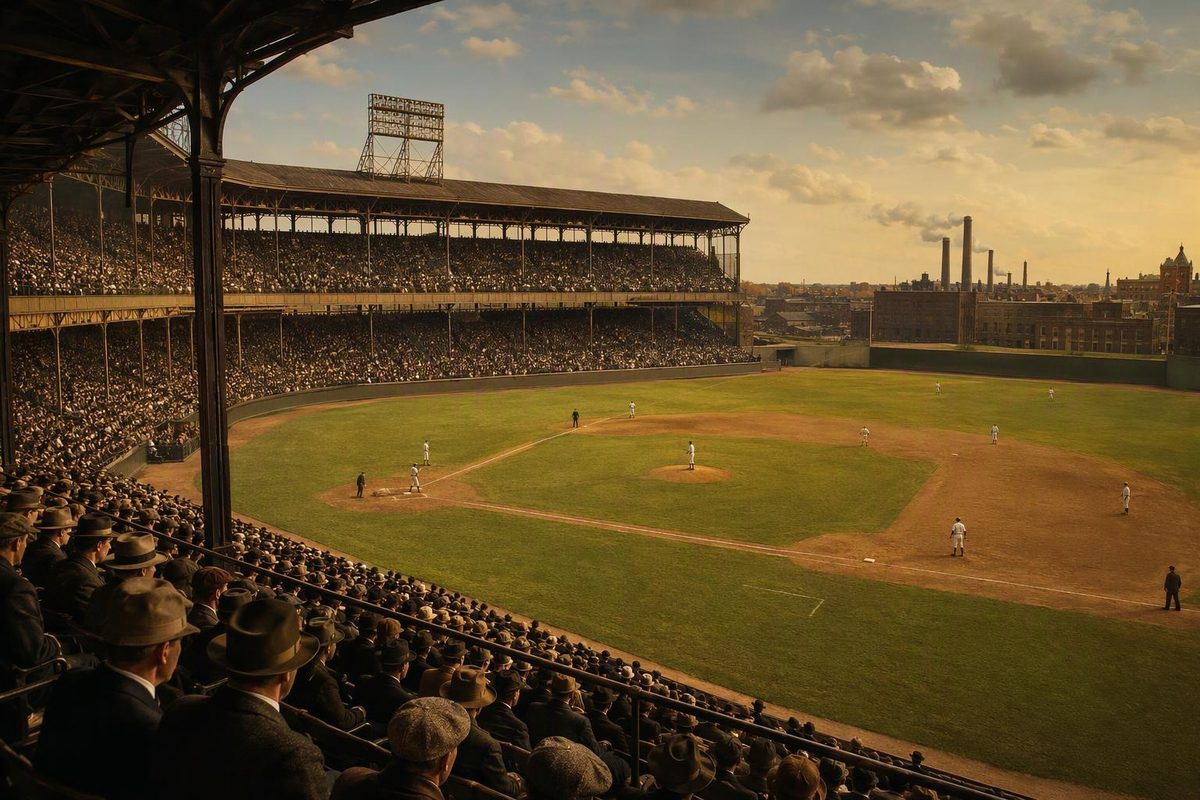
When Shibe Park opened at 21st Street and Lehigh Avenue on April 12, 1909, its importance went beyond providing a new home for the Philadelphia Athletics. The ornate North Philadelphia park was the first major-league stadium built of steel and reinforced concrete—the prototype for the permanent ballparks that soon transformed the sport.
It later became the home of the Phillies, hosted Negro League baseball and witnessed several defining performances. Renamed Connie Mack Stadium in 1953, it staged its final game in 1970 and was demolished in 1976.
Why Ben Shibe built it
The park took its name from Athletics owner Benjamin Franklin Shibe, not from the club’s better-remembered manager and part-owner, Connie Mack. Shibe’s sporting-goods business had made him wealthy, and the American League club he helped establish in 1901 quickly outgrew Columbia Park.
The A’s drew about 625,000 spectators in 1907, frequently closing their gates and turning away fans. Shibe bought a 5.75-acre block in North Philadelphia for $67,500. The site offered inexpensive land and access by trolley and railroad, although it stood beside a contagious-disease hospital that was about to close. Construction began in April 1908 and took less than a year, according to SABR’s history of the ballpark.
William Steele and Sons built the stadium with 500 tons of steel and several thousand cubic yards of reinforced concrete. The significance was structural as well as stylistic: the Historic American Buildings Survey record held by the Library of Congress identifies Shibe Park as the nation’s first reinforced-concrete stadium.
The building did not look like a utilitarian sports ground. Its brick façade had arched windows, Ionic pilasters, a green-slate mansard roof and a domed corner tower. Inside were approximately 23,000 seats, plus standing areas that could raise capacity to about 40,000. Tickets ranged from 25 cents for pavilion seats to $1 for the lower grandstand.
The city block also shaped the playing field. The original foul lines measured 378 feet in left and 340 in right, while the walls met in a square corner 515 feet from home plate in deepest center. Shibe Park was modern, but it was still an urban ballpark fitted into the land available.
An opening-day crush
The demand that inspired the project immediately overwhelmed it. On opening day, fans began lining up early in the morning. Official attendance was 30,162, but thousands more entered with passes, forced their way through gates or watched from nearby rooftops.
Mayor John Reyburn threw the ceremonial first pitch, and Eddie Plank led the Athletics to an 8-1 victory over the Boston Red Sox. Danny Murphy drove in the first run in the park’s history and finished 4-for-5. Spectators packed behind a rope in the outfield, turning balls hit into the crowd into ground-rule doubles. SABR’s account of the opener reconstructs both the game and the disorder outside the gates.
The day also acquired a tragic postscript. A’s catcher Doc Powers became ill during the game, finished it and died two weeks later. His cause of death was reported as intussusception, an intestinal condition. Later stories blamed a bad sandwich or a collision with a wall, but the historical evidence cited by SABR supports neither explanation.
The home of two Athletics dynasties
Shibe Park’s first decades tracked the rise, dismantling and rebirth of Mack’s Athletics. The club won the World Series in 1910, 1911 and 1913, then returned with a second dynasty built around Lefty Grove, Jimmie Foxx, Mickey Cochrane and Al Simmons. Those A’s won consecutive championships in 1929 and 1930 and another American League pennant in 1931; MLB’s history of the Philadelphia Athletics lists the club’s nine pennants and five championships.
The signature Shibe Park rally came in Game Four of the 1929 World Series. Chicago led 8-0 when Philadelphia scored 10 runs in the seventh inning. Simmons started the comeback with a home run; later, Cubs center fielder Hack Wilson lost Mule Haas’s drive in the sun, allowing Haas to circle the bases. The A’s won 10-8 and took a three-games-to-one Series lead. They clinched the championship at Shibe Park two days later. SABR’s game account traces all 10 runs.
Both dynasties were broken apart when the organization’s finances deteriorated. Unlike owners supported by vast outside fortunes, the Shibe and Mack families depended heavily on baseball revenue. Competition from the Federal League helped trigger the first selloff, while the Great Depression contributed to the second.
The rooftops and the “spite fence”
Shibe Park’s most famous architectural alteration grew from a dispute over who owned the view.
Residents along 20th Street could see the field from upper windows and rooftops. Some erected bleachers and sold admission; nearly 3,000 people reportedly watched the 1929 World Series from those roofs. The Athletics tolerated the trade while their own gates were strong, but declining attendance changed the calculation.
During the winter of 1934–35, the club added a 22-foot corrugated-metal extension above the right-field wall, raising the barrier to 50 feet and blocking the rooftops. It became known as Connie Mack’s “spite fence,” although Jack Shibe, Ben’s son, had driven the project. Neighbors sued and lost. Players disliked it too: potential home runs struck the wall, and its corrugated surface produced difficult caroms.
The episode captured the complicated relationship between an urban ballpark and its neighborhood. Shibe Park depended on nearby residents as customers and existed amid their homes, yet the club also treated an unobstructed view as a product that belonged to the ticket office.
The Phillies, Negro Leagues and baseball under the lights
The Phillies left the deteriorating Baker Bowl and moved into Shibe Park during the 1938 season. For the next 17 seasons, Philadelphia’s American and National League teams shared the grounds.
On May 16, 1939, Shibe Park hosted the American League’s first night game. Eight light towers illuminated a 10-inning contest won 8-3 by Cleveland. It was not major-league baseball’s first night game—Cincinnati’s Crosley Field had staged that milestone in 1935—but it marked the American League’s entry into night baseball, as SABR’s game history explains.
Shibe Park’s history also extends beyond the segregated American and National Leagues. Black teams first played there in 1919. Hilldale defeated the Kansas City Monarchs at the park to clinch the 1925 Negro League World Series, and the Philadelphia Stars later used it for selected home dates. A Stars-Monarchs game featuring Satchel Paige drew 24,165 in 1943. Jackie Robinson played there for the Monarchs in 1945, two years before returning with the Brooklyn Dodgers. SABR’s study of Negro League games at Shibe Park documents a history easily obscured when the stadium is remembered only through the A’s and Phillies.
The park also served as the Eagles’ home from 1940 through 1957, including their snow-covered victory over the Chicago Cardinals in the 1948 NFL championship game.
The performances that fixed Shibe Park in the record book
Several individual feats made the address at 21st and Lehigh inseparable from baseball’s statistical history. SABR’s park history records all three:
- On June 3, 1932, Lou Gehrig became the first major leaguer of the modern era to hit four home runs in one game.
- On September 28, 1941, Ted Williams entered a season-ending doubleheader with a batting average of .3995, which would have rounded to .400. He played both games, went 6-for-8 and finished at .406.
- On June 4, 1964, Sandy Koufax no-hit the Phillies. A walk to Richie Allen, who was then caught stealing, left Koufax facing the minimum 27 batters.
The stadium also hosted the 1943 and 1952 major-league All-Star Games.
These achievements occurred in materially different versions of the park. Stands, fences and scoreboards changed over six decades, a reminder that even statistics recorded at one address did not always arise under identical playing conditions.
From Shibe Park to Connie Mack Stadium
The stadium was renamed Connie Mack Stadium before the 1953 season, honoring the manager who had led the Athletics for 50 years. The change could not reverse the franchise’s decline. The A’s were sold after the 1954 season and moved to Kansas City, ending their 54-season Philadelphia history. The Phillies bought the stadium and remained.
By then, the advantages of the 1909 site had become liabilities. A park built for streetcars and pedestrians offered little parking for an increasingly automobile-dependent audience. Its aging structure lacked newer amenities, while poverty and racial segregation reshaped the surrounding neighborhood. The Encyclopedia of Greater Philadelphia’s stadium history places the move from neighborhood parks to the car-oriented South Philadelphia sports complex within that broader urban change.
The final game was played October 1, 1970. The Phillies beat the Montreal Expos 2-1 in 10 innings, but souvenir hunters began tearing out seats, signs and pieces of the field before the night was over. The Phillies moved to Veterans Stadium in 1971.
A fire badly damaged the abandoned building later that year. Demolition began after a 1975 court order, with the domed corner tower—the park’s defining feature—the last major section to fall, on July 13, 1976.
Shibe Park did not merely precede the classic steel-and-concrete ballparks. It established the model: a permanent civic building, architecturally ambitious and inseparable from its neighborhood. Its 62 seasons also encompassed enough change to tell a larger baseball story—from segregated leagues and daytime games to integration, night baseball and the movement of major sports facilities from city streets to parking-lot complexes.