
How the Beavers Won Three College World Series Titles
The Beavers won in 2006, 2007 and 2018. Their paths included elimination-game survival, an unbeaten Omaha run and a finals rally.
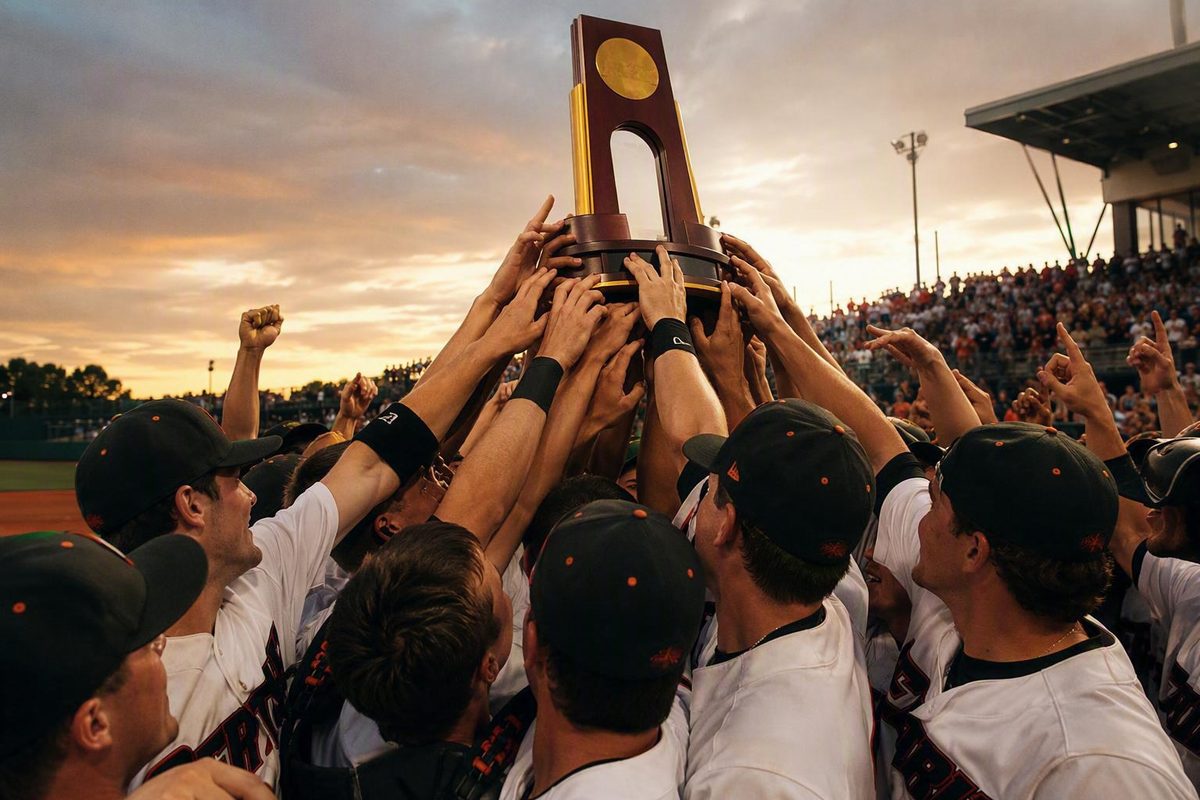
The short answer: Oregon State has three baseball national championships
Oregon State baseball has won three NCAA Division I national championships: 2006, 2007, and 2018. In this context, a College World Series title is the NCAA Division I baseball national championship. Oregon State won its first two titles in consecutive seasons before adding its third in 2018, as reflected in a contemporary breakdown of the program’s three championship teams.
| Championship year | Final season record | Finals opponent | Championship-clinching score | Head coach |
|---|---|---|---|---|
| 2006 | 50-16 | North Carolina | 3-2 | Pat Casey |
| 2007 | 49-18 | North Carolina | 9-3 | Pat Casey |
| 2018 | 55-12-1 | Arkansas | 5-0 | Pat Casey |
The records, opponents, coaches, and deciding scores come from the NCAA Division I championship ledger. The scores are those of the championship-clinching games, not summaries or aggregate scores for the complete finals.
Pat Casey coached all three champions, but the teams followed distinct paths through Omaha. The 2006 Beavers repeatedly survived elimination, the 2007 team completed College World Series play without a loss, and the 2018 club recovered from defeats in both its opening game in Omaha and the championship-series opener.
2006: Six elimination-game wins produced the first title
Oregon State’s first national championship came in 2006. The Beavers finished 50-16, faced North Carolina in the finals, and secured the title with a 3-2 victory in Omaha.
The one-run clincher was only the conclusion to a longer survival story. Oregon State won six consecutive elimination games on its way to the championship, meaning each victory extended the season and each potential loss threatened to end it. That run became the defining characteristic of the program’s breakthrough title, according to the Oregon State University Libraries oral-history project.
The championship also grew out of progress made one season earlier. Oregon State reached the College World Series in 2005 and returned in 2006, turning its second consecutive trip to Omaha into its first NCAA Division I title. The 2005 appearance did not count as a championship, but it established the immediate context for the Beavers’ rise.
That sequence matters because the 2006 title was not an isolated trip followed by an unexpected victory. Oregon State had already reached college baseball’s final stage, gained experience there, and returned the next season. Once back, however, the Beavers did not take a smooth route to the championship. Their path depended on winning repeatedly with no further defeat available.
The 3-2 result over North Carolina accurately describes the clinching game: Oregon State won by one run. It does not capture the cumulative strain of the tournament run. The stronger historical signature is the six-game elimination streak that kept the Beavers’ season alive long enough for them to win the championship.
2007: Oregon State repeated without losing in Omaha
Oregon State returned in 2007 and won a second consecutive national championship. The Beavers finished 49-18, again met North Carolina in the finals, and won the title-clinching game 9-3.
The important qualification is that Oregon State was undefeated in College World Series play, not over its entire season. The 49-18 overall record makes that distinction clear. The NCAA’s undefeated notation applies specifically to the Beavers’ performance in Omaha.
That route contrasted sharply with the previous championship. In 2006, Oregon State repeatedly had to win to prevent elimination. In 2007, the Beavers avoided the losers’ path altogether at the College World Series. Instead of recovering from defeats in Omaha, they maintained an unbeaten tournament position through the title.
Oregon State also won four tournament games by at least six runs in 2007, according to the university’s archive of the back-to-back championship era. Those margins do not mean every game was comfortable, but they show that several victories came with substantial scoreboard separation.
The 9-3 clinching win over North Carolina fit that pattern. Its six-run margin was notably different from the one-run clincher in 2006, but final-game scores alone cannot measure the difficulty of complete tournament runs. The more meaningful contrast lies in tournament position: the 2006 Beavers repeatedly escaped elimination, while the 2007 team never lost in Omaha.
North Carolina remained the finals opponent, making the repeat unusually direct: the same champion defeated the same runner-up in consecutive seasons. Yet Oregon State did not simply reproduce its first title run. It defended the championship through a different form of postseason control.
The back-to-back era changed Oregon State’s championship history
The seasons from 2005 through 2007 form one sustained chapter in Oregon State baseball history. The Beavers reached the College World Series in all three years and won the national championship in the latter two.
The distinction between appearances and championships is essential. Reaching Omaha in 2005 demonstrated that Oregon State had advanced to the final stage of the NCAA tournament. Only the victories in 2006 and 2007 added national titles to the program’s record.
Those consecutive championships created the first distinct phase of Oregon State’s title history. Before the 2006 breakthrough, the program had no NCAA Division I baseball championship. By the end of the following season, it had two.
Pat Casey was the central connecting figure. Players and tournament circumstances changed, but the head coach remained the same across every title team.
The clinching games offer a simple numerical contrast. Oregon State closed the 2006 championship with a 3-2 victory and finished the 2007 title run with a 9-3 win. The first was decided by one run and the second by six, but those margins should not be treated as complete verdicts on the two tournaments.
The better comparison is structural. The 2006 team survived six consecutive elimination games. The 2007 team went undefeated in College World Series play and recorded several tournament victories by margins of at least six runs. One championship was defined by recovering when the season was repeatedly at risk; the other was defined by avoiding defeat in Omaha.
The university’s oral-history collection adds personal perspective to that period through interviews with coach Pat Casey, players Kevin Gunderson and Chris Kunda, and broadcaster Mike Parker. Those retrospective interviews serve a different purpose from the NCAA championship ledger: the NCAA establishes the official results, while the oral histories preserve how participants and observers remembered the back-to-back era.
2018: A finals comeback delivered the third championship
Oregon State returned to the top of college baseball in 2018. The Beavers finished 55-12-1 under Pat Casey and won the program’s third national championship.
Their College World Series run began with a loss, immediately moving them into elimination play. Oregon State then won four consecutive elimination games to reach the championship series. After dropping the finals opener, the Beavers ultimately won six of their final seven games in Omaha, according to the NCAA’s account of the comeback.
Arkansas won the first championship-series game 4-1, leaving Oregon State one defeat from losing the finals. The Beavers answered with a 5-3 victory and then won the deciding game 5-0:
- Arkansas 4, Oregon State 1
- Oregon State 5, Arkansas 3
- Oregon State 5, Arkansas 0
Oregon State clinched the championship on June 28, 2018, in Omaha. The complete three-game finals sequence explains why the NCAA ledger lists 5-0: that was the score of the deciding game, not the result of the series as a whole.
The comeback unfolded in two stages. First, Oregon State recovered from its opening College World Series defeat and navigated four elimination games to earn a place in the finals. Then, after Arkansas took the series lead, the Beavers won the two games they could not afford to lose.
That structure makes “comeback” a literal description. Oregon State was not undefeated in Omaha and did not control the championship series from the start. It lost its opening game at the College World Series, recovered to reach the finals, lost again, and responded with consecutive victories.
The 2018 run therefore resembled 2006 more than 2007 in one important respect: both championship teams spent substantial time facing elimination. The endings were nevertheless distinct. In 2018, the defining final sequence was a 5-3 win to extend the series followed by a 5-0 shutout to claim the title.
Kevin Abel and Adley Rutschman defined the 2018 finish
Kevin Abel delivered the decisive pitching performance against Arkansas. He threw a complete-game, two-hit shutout with 10 strikeouts and, after allowing a third-inning infield single, retired the final 20 batters he faced. Oregon State’s 5-0 victory completed the championship, as detailed in the NCAA’s review of the title run.
“Complete game” means Abel recorded every out for Oregon State, while “shutout” means Arkansas did not score. His performance ensured that the Beavers did not need another late reversal after rallying to win the previous game. Oregon State built a lead, and Abel protected it through the final out.
Adley Rutschman supplied the defining position-player performance across the event. He was named the 2018 College World Series Most Outstanding Player after collecting 17 hits in eight games, identified in the contemporary reports as a College World Series record.
Rutschman’s award reflected his work throughout Oregon State’s stay in Omaha rather than one championship game. The Beavers’ broader offensive totals support that context: Oregon State recorded 93 hits and batted .327 over eight College World Series games, according to the university’s 2018 championship retrospective.
The deciding victory also marked Pat Casey’s 900th career win. One result therefore completed both Oregon State’s third national championship and a major coaching milestone.
Abel and Rutschman represented different dimensions of the title. Abel controlled the deciding game with a complete-game shutout and retired the final 20 Arkansas hitters. Rutschman’s 17-hit tournament and Most Outstanding Player award reflected sustained production over the complete College World Series.
How to read Oregon State’s championship record accurately
Oregon State’s championship record is straightforward, but several distinctions prevent common misunderstandings.
First, a College World Series appearance is not automatically a national championship. Reaching Omaha means a team advanced to the final stage of the NCAA tournament. Winning there makes the team the NCAA Division I champion. Oregon State appeared in 2005 but won championships in 2006, 2007, and 2018.
Second, an undefeated College World Series run is not the same as an undefeated season. Oregon State’s 2007 team finished 49-18 overall. Its undefeated designation applies only to College World Series play.
Third, the score listed in the NCAA championship history is the championship-clinching result. It does not necessarily represent an entire best-of-three finals. This is especially important for 2018: Arkansas won the first game, Oregon State won the second, and the Beavers’ 5-0 victory in the third game decided the championship.
Fourth, different sources serve different functions. The official NCAA championship table should anchor the basic record: title year, season record, coach, opponent, deciding score, and site. University archives and athletics retrospectives provide additional detail about tournament paths, individual performances, and the memories of participants.
That approach also limits the risk of stretching a compact record beyond what it says. A clinching score can establish the result of the deciding game, but it cannot by itself reconstruct a full championship series. Similarly, a season record does not explain whether a team won by surviving elimination or by remaining unbeaten in Omaha.
The documented championship ledger is 2006, 2007, and 2018. The historical significance lies in the different routes: repeated elimination-game survival in 2006, an undefeated College World Series run in 2007, and a two-game finals rally against Arkansas in 2018.
What years did Oregon State baseball win national championships?
Oregon State won the NCAA Division I baseball national championship in 2006, 2007, and 2018. Those are also the program’s three College World Series titles, as summarized in the contemporary championship-team breakdown.
Who coached Oregon State to all three baseball national championships?
Pat Casey coached Oregon State’s championship teams in 2006, 2007, and 2018. The 2018 title-clinching victory was also his 900th career win, according to Oregon State’s championship retrospective.
Did Oregon State win back-to-back College World Series titles?
Yes. Oregon State won consecutive College World Series championships in 2006 and 2007. The Beavers also reached Omaha in 2005, but that season ended with an appearance rather than a championship, as reflected in the program history summarized by Baseball Reference’s BR Bullpen.
Who did Oregon State defeat in each championship-clinching game?
Oregon State defeated North Carolina in the 2006 and 2007 championship-clinching games, then beat Arkansas in the 2018 decider. The respective scores were 3-2, 9-3, and 5-0, according to the NCAA championship history.
What happened in the deciding game of the 2018 College World Series?
Oregon State beat Arkansas 5-0 on June 28, 2018. Kevin Abel pitched a complete-game, two-hit shutout, struck out 10, and retired the final 20 batters he faced. The victory gave Oregon State its third championship and marked Pat Casey’s 900th career win, as documented in the Oregon State Athletics retrospective.
The final ledger is 2006, 2007, and 2018, all under Pat Casey. Oregon State survived six consecutive elimination games to win its first championship, repeated the next year without losing in College World Series play, and captured its third with two straight victories over Arkansas, capped by Abel’s deciding-game shutout.